SEO vs SEM: How Do They Work Together?
Search Engine Optimization (SEO) and Search Engine Marketing (SEM) both use search engines such as Google to increase online visibility, attract visitors, and support business growth. Although these terms are sometimes used interchangeably, they represent different approaches to search marketing.
SEO focuses primarily on improving organic search rankings through quality content, technical optimization, relevant keywords, backlinks, and a positive user experience. SEM generally refers to paid search advertising, where businesses pay to appear prominently for targeted search queries.
Understanding the difference between SEO and SEM helps marketers choose the right strategy based on their goals, budget, audience, and search intent. While SEO can provide sustainable long-term visibility, SEM can generate faster traffic, leads, and conversions through targeted advertising campaigns.
Search marketing continues to evolve as Google updates its algorithms and introduces new technologies. Recent developments, including greater insights into search ranking systems, have increased interest in how websites are evaluated and ranked.
Artificial intelligence (AI) is also changing the search landscape by influencing content creation, search experiences, advertising, and user behaviour. In this guide, we explore the key differences between SEO and SEM, effective ways to use both strategies, and how businesses can adapt their search marketing efforts to improve visibility, traffic, and online performance.
What’s the difference between SEO and SEM?
Search Engine Optimization (SEO) and Search Engine Marketing (SEM) are both designed to improve a website’s visibility in search results, but they use different approaches. Understanding the difference between SEO and SEM can help businesses choose the right strategy for attracting their target audience.
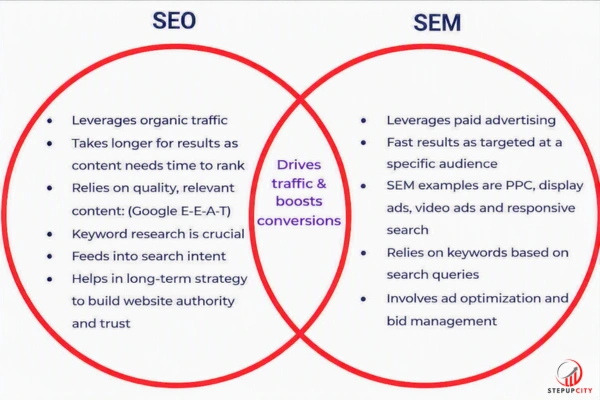
SEO focuses on increasing organic traffic by optimizing website content, keywords, technical performance, user experience, and backlinks. It does not require businesses to pay for every click and is generally considered a long-term digital marketing strategy.
SEM is a broader search marketing approach that can include both organic and paid search activities. Paid SEM commonly involves Pay-Per-Click (PPC) advertising, where businesses bid on relevant keywords to display ads to potential customers. These campaigns can generate targeted traffic and leads more quickly.
In simple terms, SEO focuses mainly on organic visibility, while SEM can combine organic search strategies with paid advertising.
The search landscape is continually changing due to evolving user behaviour, artificial intelligence, and AI-powered search features such as Google AI Overviews. These developments are influencing how marketers approach search visibility and paid advertising.
How Does SEO Work?
Search Engine Optimization (SEO) is the ongoing process of improving a website so it can rank higher in organic search engine results pages (SERPs). Search engines such as Google and Bing crawl, analyse, and evaluate web pages to determine which content is most relevant and useful for a search query.
SEO considers several factors, including:
- Keywords: Matching content with relevant search queries.
- Content quality: Providing useful, original, and informative information.
- Technical SEO: Improving website speed, structure, mobile usability, and crawlability.
- Authority: Building credibility through relevant, high-quality links.
- User experience: Making content easy to navigate and understand.
Google remains the dominant search engine, making it the primary focus for most SEO strategies. However, rankings do not happen instantly, especially for new websites. Search engines need time to discover, understand, and evaluate content.
The key to successful SEO is understanding search intent: identify what your audience is searching for and create valuable content that directly answers their needs.
SEO Categories
SEO can be divided into four key categories: technical SEO, on-page SEO, off-page SEO, and local SEO. Each plays an important role in improving search visibility, website performance, and organic traffic.
- Technical SEO
Technical SEO focuses on the website’s technical health and backend structure. It helps search engines crawl, understand, and index your pages effectively.
Key areas include:
- Website architecture
- Page speed and mobile performance
- Broken links
- Metadata errors
- Crawlability and indexing
- Website security
- On-Page SEO
On-page SEO focuses on optimizing the content and elements visitors see on your website. Keyword research helps you understand what your audience searches for and create content that meets their needs.
Important elements include:
- Page titles
- Headings
- URLs
- Keyword placement
- Content quality
- Internal linking
- Image optimization
- Off-Page SEO
Off-page SEO focuses on building your website’s credibility and authority outside your own site. Quality backlinks, digital PR, brand mentions, and relevant media coverage can strengthen your online reputation.
- Local SEO
Local SEO helps businesses appear in location-based searches and attract nearby customers. Using relevant local keywords and maintaining an optimized Google Business Profile can improve visibility in local search results and Google Maps.
Key SEO Features and Ranking Factors
Search engines use many signals to evaluate websites and determine which pages should appear for specific searches. Rather than focusing on a single factor, an effective SEO strategy combines content quality, technical performance, authority, and user experience.
Here are the key SEO features businesses should focus on:
- Keyword Optimization – Research relevant keywords using tools such as Google Keyword Planner, Semrush, or Ahrefs. Use them naturally in titles, headings, URLs, content, and metadata without keyword stuffing.
- Content Creation and Optimization – Publish original, useful, accurate, and engaging content that addresses your audience’s questions, needs, and search intent.
- User Experience (UX) – Create a fast, easy-to-navigate website with clear content, intuitive menus, readable layouts, and mobile-friendly pages.
- Link Building – Earn relevant, authoritative backlinks from trustworthy websites. Quality and relevance matter more than simply acquiring a large number of links.
- Voice Search Optimization – Optimize content for conversational queries and natural-language searches by answering common questions clearly and concisely.
- Schema Markup – Use structured data to help search engines better understand your content and potentially qualify pages for enhanced search features.
- Core Web Vitals – Monitor page loading performance, responsiveness, and visual stability to provide a smoother user experience.
- Video SEO – Optimize videos with descriptive titles, relevant descriptions, transcripts, thumbnails, and supporting content to improve discoverability.
- Mobile SEO – Ensure your website works smoothly across smartphones and tablets. Responsive design, fast loading, and easy navigation are essential.
- Social Sharing – Make valuable content easy to share across social platforms. Social engagement can increase content exposure, referral traffic, and brand awareness.
- E-E-A-T – Demonstrate Experience, Expertise, Authoritativeness, and Trustworthiness through accurate content, credible sources, transparent authorship, and strong brand credibility. E-E-A-T itself is not a single ranking factor, but these qualities help support content quality.
How to Get Results with SEO
Achieving strong SEO results requires a consistent strategy that combines relevant keywords, high-quality content, technical optimization, and a positive user experience.
Keywords
Use relevant, high-intent, and long-tail keywords naturally throughout landing pages, blogs, and product pages. Include primary keywords in titles, meta descriptions, headings, and URLs without keyword stuffing.
Content
Create useful content based on your audience and buyer personas. Regularly update existing pages, publish evergreen resources, use internal links, and create original research, guides, templates, and case studies that provide genuine value.
User Experience
Improve website navigation, structure, readability, loading speed, and cross-browser compatibility. A smooth experience encourages visitors to stay and engage with your content.
Link Building
Develop a strong internal linking structure and earn relevant backlinks through outreach and valuable, linkable content. Monitor your backlink profile regularly.
Voice & Video SEO
Optimize content for conversational searches, questions, and long-tail keywords. For videos, optimize titles, descriptions, transcripts, captions, and supporting content.
Mobile SEO
Ensure your website is responsive, fast, easy to navigate, and optimized for mobile-first indexing.
E-E-A-T
Demonstrate experience, expertise, authority, and trust through credible authors, accurate information, and industry knowledge.
Analysis & Security
Use Google Analytics and Search Console to track performance and improve strategies based on data. Secure your website with HTTPS and maintain accurate XML sitemaps submitted through Search Console.
How Does SEM Work?
Search Engine Marketing (SEM) generally focuses on paid search strategies that help businesses increase visibility, reach targeted audiences, and drive traffic through search engines. While SEO primarily focuses on organic rankings, SEM often uses paid advertising to generate faster and more targeted results.
SEM allows marketers to select specific keywords, audiences, locations, budgets, and bidding strategies to reach potential customers when they are actively searching for relevant products or services. Although rising AI-powered search is changing how people discover information online, paid search remains an important part of many digital marketing strategies.
A successful SEM campaign typically involves creating relevant advertisements, selecting appropriate keywords, setting a budget, and continuously monitoring performance. Businesses can then optimize campaigns based on clicks, conversions, cost per lead, and return on advertising spend.
Common SEM Advertising Activities
- PPC advertising: Google Ads and other paid search campaigns.
- Display advertising: Banner ads and remarketing campaigns.
- Video advertising: Ads on platforms such as YouTube.
- Local advertising: Location-focused ads that reach nearby customers.
- Social media advertising: Paid campaigns across major social platforms.
- Responsive search ads: Flexible ads that adapt to different searches.
- Voice search advertising: Reaching users through voice-based searches.
- Geotargeting: Showing advertisements to audiences in specific locations.
SEM can complement SEO by providing immediate visibility while organic search strategies develop over time.
SEM Key Features
Search Engine Marketing (SEM) offers several features that help businesses reach targeted audiences, control advertising costs, and measure campaign performance. By combining these tools effectively, marketers can create more focused and results-driven paid search campaigns.
- Keyword Targeting – Select relevant keywords that potential customers use when searching. Broad, phrase, and exact match options can help control how closely searches match your ads.
- Bidding – Set bids for targeted keywords and optimize them according to campaign goals, such as generating leads, increasing sales, or driving website traffic.
- Ad Creation & Optimization – Create engaging advertisements with relevant headlines, descriptions, and clear calls to action. Regular testing can help identify better-performing ad variations.
- Budget Control – Set daily or monthly spending limits and adjust bids according to campaign performance, keywords, and ad groups.
- Audience Targeting – Reach specific users based on factors such as location, age, interests, demographics, online behaviour, and search activity.
- Analytics & Reporting – Track important metrics such as impressions, clicks, conversions, cost per click, and return on advertising spend to evaluate campaign effectiveness.
- Negative Keywords – Exclude irrelevant search terms to prevent ads from appearing for unsuitable queries and reduce unnecessary advertising costs.
Using these SEM features strategically allows businesses to build targeted, measurable, and cost-effective campaigns while continuously optimizing performance and improving conversions.
How to Get Results with SEM
Getting strong results from Search Engine Marketing (SEM) requires careful planning, continuous optimization, and accurate performance tracking. A well-structured SEM strategy can improve visibility, attract qualified visitors, and increase conversions.
Keyword Research & Targeting
Identify relevant keywords your audience searches for. Focus on high-intent terms and use tools such as Google Keyword Planner to discover suitable opportunities based on search volume, competition, and relevance.
Ad Copy Optimization
Create clear, persuasive advertisements that include relevant keywords, highlight your unique selling points, and feature a strong call to action (CTA).
Landing Page Optimization
Ensure landing pages closely match your advertisements. Provide useful information, simple navigation, fast loading times, and a seamless experience across devices.
Bid & Budget Management
Monitor keyword performance, competition, and spending regularly. Adjust bids according to campaign goals and consider automated bidding when appropriate.
Ad Extensions
Use relevant ad extensions, such as sitelinks and structured snippets, to provide additional information and improve ad visibility.
A/B Testing
Test different headlines, descriptions, landing pages, audiences, and targeting settings to identify the combinations that deliver better results.
Retargeting
Use remarketing campaigns to reconnect with users who previously visited your website or interacted with your advertisements.
Conversion Tracking
Track valuable actions such as purchases, enquiries, registrations, downloads, and form submissions to measure campaign effectiveness.
Location & Device Targeting
Target specific locations and adjust campaigns according to audience behaviour across mobile, desktop, and tablet devices.
How Can You Use SEO and SEM Together?
SEO and SEM are complementary search marketing strategies that can work together to increase website visibility, attract qualified traffic, and generate conversions. Both rely on relevant keywords, but SEM also uses paid advertising to reach potential customers quickly.
A combined strategy allows businesses to benefit from both organic and paid search channels.
Use SEO & SEM Together
- Share keyword data: Use high-performing PPC keywords to identify opportunities for SEO content and organic ranking.
- Improve paid campaigns: Use SEO search intent and organic performance data to refine SEM targeting and ad copy.
- Capture more visibility: Appearing in both organic and paid results can increase your brand’s presence for valuable searches.
- Target different stages: Use SEO to build long-term organic visibility while SEM generates immediate targeted traffic.
- Optimize conversions: Compare traffic and conversion data from both channels to identify what attracts and converts your audience.
- Strengthen website credibility: A technically sound, useful, and user-friendly website supports both SEO performance and paid campaign landing pages.
Why Combine SEO and SEM?
SEO can provide sustainable organic traffic over time, while SEM can deliver targeted visitors more quickly. Using both strategies creates multiple opportunities to reach customers throughout their search journey.
The key is to share insights between your SEO and SEM campaigns. When keyword, audience, and conversion data are analyzed together, businesses can make smarter marketing decisions, improve search visibility, and build a stronger overall digital marketing strategy.
Here’s a simple guide to help you decide when to choose SEO or SEM for your online marketing needs:
| Situation | Opt for SEO | Opt for SEM |
|---|---|---|
| Brand Building | Suitable for long-term brand recognition and authority. | Provides immediate visibility and brand exposure. |
| Budget | Economical over time, especially for organic rankings. | Requires a flexible budget for bidding on keywords. |
| Competition | Effective for less competitive niches or long-tail keywords. | Ideal for highly competitive markets or short-term promotions. |
| Time Sensitivity | Results may take longer to materialize but can provide lasting value. | Offers quick results, making it ideal for time-sensitive campaigns. |
| Organic Traffic | Focuses on improving organic search rankings. | Generates paid traffic through targeted advertising campaigns. |
SEO and SEM: Future Directions
The future of SEO and SEM is evolving rapidly as search engines become more intelligent, user behaviour changes, and AI transforms how people discover information. Businesses need to focus on relevance, credibility, technical performance, and search intent to remain competitive.
- Artificial Intelligence and Machine Learning: Search engines increasingly use AI to understand context and user intent. Create useful, accurate content that directly answers audience needs.
- AI-Powered SEO and SEM Tools: AI tools can support keyword research, content planning, campaign optimization, competitor analysis, and audience insights. Use them to improve efficiency while maintaining human oversight.
- Google Algorithm Updates: Search algorithms continuously evolve. Marketers should monitor major updates and focus on sustainable SEO practices rather than trying to manipulate individual ranking signals.
- Expertise and Authority: Demonstrating genuine experience, expertise, authoritativeness, and trustworthiness is becoming increasingly important. Build topic-focused content hubs and publish original research or insights.
- Zero-Click Searches: Users may find answers directly on search results pages without visiting a website. Optimizing for featured snippets and other search features can improve visibility and brand recognition.
- YouTube Search: Video continues to play an important role in search discovery. Optimizing YouTube content can help businesses reach new audiences through both organic and paid strategies.
- Emerging Search Platforms: Platforms such as TikTok are increasingly being used for discovery and research. Businesses should adapt their content strategies to reach audiences across multiple search environments.
Conclusion
SEO and SEM are essential components of a successful digital marketing strategy, but each serves a different purpose. SEO focuses on improving organic search visibility, building website authority, and generating sustainable long-term traffic. SEM uses paid search advertising to deliver faster visibility, targeted traffic, and measurable results. By combining SEO and SEM, businesses can reach potential customers through both organic and paid channels. Using keyword insights, audience data, quality content, optimized landing pages, and performance tracking can further strengthen search marketing efforts. A balanced approach allows businesses to increase online visibility, attract qualified leads, improve conversions, and build lasting digital growth.
Frequently Asked Questions
SEO focuses on improving a website’s organic search visibility, while SEM generally involves paid search advertising to generate targeted traffic and faster visibility.
Neither is universally better. SEO is suitable for long-term organic growth, while SEM can provide faster traffic and immediate visibility. Using both can create a well-rounded search marketing strategy.
SEO improves website visibility by optimizing content, keywords, technical performance, user experience, internal links, and other factors that help search engines understand and rank web pages.
SEM uses paid advertising to display a business prominently for relevant search queries. Advertisers can target specific keywords, audiences, locations, and devices while controlling campaign budgets.
Yes. SEO and SEM work well together. Businesses can use PPC keyword data to identify SEO opportunities and use organic search insights to improve paid campaigns.
SEO usually takes longer than paid advertising because search engines need time to discover, evaluate, and rank content. Results vary depending on competition, website authority, content quality, and technical performance.
Generally, yes. A properly configured SEM campaign can begin generating impressions, clicks, and traffic soon after advertisements become active, while SEO typically requires more time to build organic visibility.
Keywords help businesses understand what their target audience searches for. SEO uses keywords to optimize organic content, while SEM uses them to target relevant paid search advertisements.
AI is changing how search engines understand queries, generate results, and present information. Marketers increasingly need to focus on search intent, helpful content, expertise, credibility, and user experience.
The right choice depends on its goals, budget, competition, and timeframe. SEO can support sustainable visibility, while SEM can help generate immediate targeted traffic. A combination may be effective when resources allow.