

What is Schema Markup And How it helps in SEO?
Schema markup is a type of structured data that helps search engines and AI systems understand the meaning of your content, not just the words on the page. By adding schema to your website, you provide clear information about your content, making it easier for search engines to interpret and display it in relevant search results.
Schema markup was introduced in 2011 through Schema.org, a collaborative initiative created by Google, Microsoft, Yahoo, and later Yandex. Before its introduction, search engines often struggled to understand the context of web content. For example, a term like “Jaguar” could refer to the animal, the luxury car brand, or a sports team, making accurate search interpretation difficult.
Schema.org established a universal vocabulary that allows website owners to describe their content in a consistent format. Think of schema markup as a digital label that tells search engines exactly what each piece of information represents.
Instead of relying solely on natural language processing to interpret unstructured text, schema markup converts content into structured data with clearly defined entities and properties. This improves search accuracy, enhances AI understanding, increases the chances of earning rich results, and strengthens your website’s overall SEO performance. Implementing schema markup helps search engines deliver more relevant information to users while improving your site’s visibility in search results.
Why Is Schema Markup Important for SEO?
Implementing schema markup is one of the most effective ways to improve your website’s visibility in search engines and AI-powered search experiences. Structured data helps Google understand your content more accurately, increasing the likelihood of your pages appearing as rich results (also known as rich snippets). These enhanced search listings can display additional information such as star ratings, FAQs, product prices, reviews, events, recipes, and business details, making your listing more attractive and improving click-through rates.
Schema markup also plays a growing role in AI SEO. Modern AI search engines and generative AI tools rely on structured data to interpret, summarise, and reference website content accurately. Properly implemented schema increases the chances of your content being featured in AI-generated summaries and search experiences.
Studies have found that many high-ranking websites use schema markup, yet a large number of websites still fail to implement it. This presents an excellent opportunity to gain a competitive SEO advantage.
Benefits of Schema Markup
- Improves search engine understanding of your content.
- Increases eligibility for rich snippets and enhanced search results.
- Boosts visibility and click-through rates in Google Search.
- Reduces ambiguity by clearly defining content entities.
- Helps AI systems accurately interpret and cite your content.
- Strengthens your website’s topical authority and knowledge graph.
- Supports long-term SEO, AEO (Answer Engine Optimisation), and GEO (Generative Engine Optimisation) strategies.
How To Implement Schema
Adding schema markup to your website is now easier than ever, thanks to user-friendly SEO tools and plugins. Whether you’re using WordPress or another content management system (CMS), implementing structured data can improve your SEO, increase your chances of earning rich results, and help AI-powered search engines better understand your content.
1. Implement Schema Markup on WordPress
If your website runs on WordPress, you can add schema markup without any coding knowledge by using SEO plugins. Popular options include Rank Math, Yoast SEO, and Schema Pro, which automatically generate structured data for pages, posts, products, FAQs, and more.
Benefits of WordPress schema plugins:
- Easy setup with beginner-friendly interfaces
- Automatic schema generation
- Support for Article, FAQ, Local Business, Product, and Breadcrumb schema
- WooCommerce integration for eCommerce websites
Tip: Use only one schema plugin to avoid duplicate structured data.
2. Add Schema Markup Manually
If your CMS doesn’t support schema plugins, you can manually add JSON-LD schema markup to your website’s <head> section. Online schema generators can help create the required code, which can then be added to your site’s HTML.
3. Test Your Schema
After implementation, validate your structured data using Google’s Rich Results Test to identify errors and confirm your pages are eligible for rich results.
4. Use AI to Generate Schema
AI tools such as ChatGPT can generate accurate JSON-LD schema markup for articles, products, FAQs, local businesses, recipes, events, and more. Simply describe your webpage, and the AI can create the appropriate structured data, explain each property, and help troubleshoot validation errors.
By implementing schema markup correctly, you improve search engine understanding, enhance AI visibility, increase eligibility for rich snippets, and strengthen your overall SEO performance.
What is the recommended format for implementing Schema Markup?
There are three main formats for implementing schema markup: JSON-LD, Microdata, and RDFa. Among these, Google recommends JSON-LD because it is the easiest format for both search engines and developers to read and maintain. JSON-LD (JavaScript Object Notation for Linked Data) can be added directly to a webpage without changing the visible content, making implementation simple and efficient. It is the preferred choice for SEO because it improves search engine understanding, supports rich results, and is easier to update than Microdata or RDFa. For most websites, JSON-LD is the best schema markup format.
What Types of Schema Markup are there?
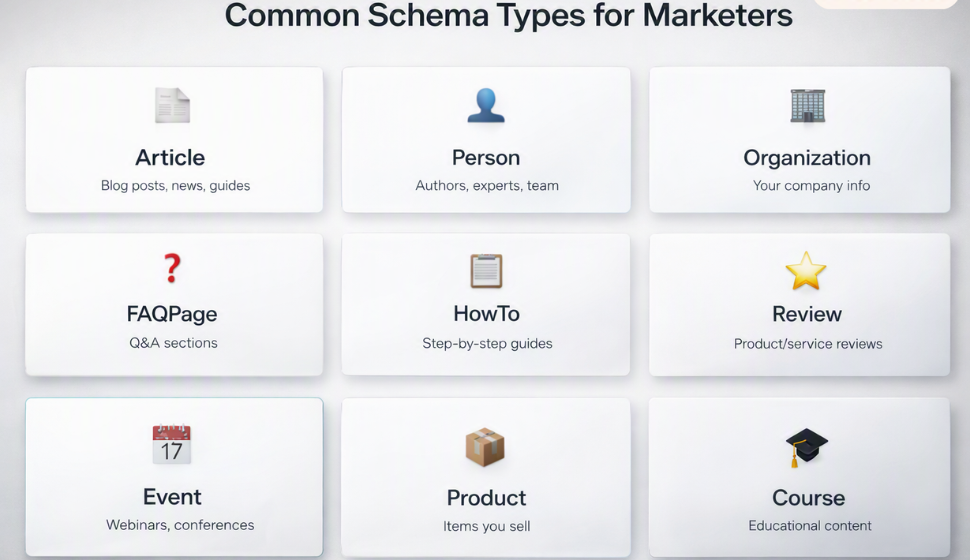
Schema markup comes in many different types, each designed to help search engines better understand specific content. Below are some of the most commonly used schema markup types for improving SEO and search visibility:
Schema For Content Publishers And Bloggers
- Article Schema
Article Schema is one of the most important types of structured data for blogs, news articles, and educational content. It provides search engines with essential information such as the article title, author, publication date, featured image, and publisher. This helps Google understand your content, establish credibility, and improve eligibility for rich search results. Most SEO plugins automatically generate Article Schema, making it easy to implement.
- Breadcrumb Schema
Breadcrumb Schema displays your website’s navigation path in search results, helping both users and search engines understand your site’s structure. It improves user experience, simplifies navigation, and enhances internal linking, making it easier for search engines to crawl your website.
- FAQ Schema
FAQ Schema organises frequently asked questions and answers into structured data. Although Google now displays FAQ rich results less frequently, FAQ Schema remains valuable for SEO because it helps search engines and AI tools better understand your content. It can also improve visibility in AI-powered search experiences by clearly identifying the questions your page answers.
- How-To Schema
How-To Schema is ideal for step-by-step tutorials and instructional content. It identifies each step, required tools, materials, images, and estimated completion time, making it easier for search engines to understand and display your guides. This schema type is especially useful for DIY articles, recipes, maintenance guides, and educational content while also supporting AI-generated search summaries and answer engines.
Schema for local businesses
LocalBusiness Schema is one of the most important types of schema markup for businesses that serve customers in a specific location. It helps search engines understand essential business information, including your business name, address, phone number (NAP), operating hours, website, geographic coordinates, customer reviews, and services offered.
Implementing LocalBusiness Schema improves your local SEO by making it easier for Google to display your business in Google Search, Google Maps, the Local Pack, Knowledge Panels, and AI-powered search results. It also helps potential customers quickly find accurate business information when searching for products or services in their area.
Benefits of LocalBusiness Schema
- Improves local search visibility and rankings.
- Increases your chances of appearing in Google’s Local Pack.
- Helps search engines verify your business information.
- Enhances visibility in Google Maps and AI search experiences.
- Builds trust by displaying accurate business details.
- Supports higher click-through rates and local customer enquiries.
For the best SEO results, ensure your LocalBusiness Schema matches the information listed on your Google Business Profile, including your business name, address, phone number, website, and opening hours. Keeping this information consistent across all online platforms strengthens your local search presence, improves credibility, and helps attract more customers to your business.
Schema for eCommerce sites
For online stores, Product Schema is an essential type of schema markup that helps search engines understand and display detailed product information. It provides structured data such as the product name, description, price, currency, availability, SKU, brand, images, and shipping details. By implementing Product Schema, your products become eligible for enhanced search listings, increasing visibility and attracting more qualified shoppers.
Adding Review Schema and AggregateRating Schema alongside Product Schema further strengthens your eCommerce SEO. These schema types display customer reviews and star ratings directly in search results, helping build trust before users even visit your website. Positive ratings can improve click-through rates and encourage potential customers to choose your products over competitors.
Benefits of Product, Review, and AggregateRating Schema include:
- Improves product visibility in Google Search and Google Shopping.
- Enables rich product snippets with prices, availability, and ratings.
- Increases click-through rates and qualified traffic.
- Builds customer trust through verified reviews.
- Helps AI-powered search engines and shopping assistants understand product information.
- Enhances the overall shopping experience and supports higher conversions.
Implementing these schema markup types ensures search engines receive accurate product information, making your eCommerce website more competitive. By providing structured data, you improve SEO performance, increase product discoverability, and create more opportunities to generate traffic, leads, and online sales.
Essential schema for every business
Organization Schema and Event Schema
Organization Schema is an essential type of schema markup that helps search engines clearly identify your business and understand its key details. It includes structured information such as your business name, logo, website URL, contact information, address, social media profiles, and other important company details. Implementing Organization Schema on your homepage improves brand recognition, strengthens your online identity, and increases the chances of appearing in Google Knowledge Panels and AI-powered search results.
Benefits of Organization Schema:
- Builds a strong brand identity.
- Improves search engine understanding.
- Supports Knowledge Panel visibility.
- Helps AI platforms recognise your business.
- Enhances SEO and brand credibility.
Event Schema is ideal for promoting conferences, webinars, workshops, product launches, concerts, and other scheduled events. It provides structured information including the event name, organiser, date, time, location, ticket details, pricing, and attendance options. Search engines use this data to display rich event listings that make your events easier to discover.
Benefits of Event Schema:
- Improves event visibility in search results.
- Displays important event details directly in Google.
- Supports online, offline, and hybrid events.
- Increases registrations and attendance.
- Helps AI search engines understand and recommend events.
By implementing Organization Schema and Event Schema, businesses can strengthen their SEO strategy, improve online visibility, enhance brand authority, and attract more customers and event participants.
Common Schema Markup Mistakes to Avoid
Implementing schema markup can significantly improve your SEO, but even small errors can prevent search engines from understanding your structured data. Avoid these common mistakes to maximise the benefits of schema markup and improve your website’s search performance.
- Choosing the Wrong Schema Type
Always use the schema type that best matches your content. For example, use Product Schema for product pages, Article Schema for blog posts, and Restaurant Schema instead of the more generic LocalBusiness Schema for restaurants.
- Missing Required Properties
Every schema type requires specific information. Missing details such as product name, price, availability, author, or publication date may cause validation errors and prevent rich results from appearing.
- Adding Duplicate Schema
Using multiple SEO plugins or themes that generate the same structured data can create duplicate schemas. This confuses search engines and may trigger errors in Google Search Console.
- Invalid JSON-LD Code
Syntax errors such as missing commas, incorrect brackets, or invalid date formats can break your entire schema markup. Always validate your JSON-LD code before publishing.
- Marking Up Hidden or Inaccurate Content
Schema markup must accurately reflect the visible content on your webpage. Avoid adding fake reviews, misleading information, or hidden content, as this violates Google’s structured data guidelines.
Regularly testing your schema markup helps ensure accurate implementation, improves SEO performance, increases eligibility for rich results, and enhances visibility in both search engines and AI-powered search experiences.
In Conclusion
Implementing schema markup is one of the most effective ways to improve your website’s SEO, increase search visibility, and help search engines and AI platforms better understand your content. From rich snippets and local search results to AI-powered search experiences, structured data gives your website a competitive advantage while enhancing user experience. Whether you run a blog, business website, or eCommerce store, using the right schema types can drive more traffic, leads, and conversions.
Ready to unlock the full potential of your website? StepUpCity specialises in SEO, technical SEO, and structured data implementation to help your business rank higher and grow faster. Contact StepUpCity today and let our experts optimise your website for better search performance and long-term digital success.
Frequently Asked Questions
Schema markup is a type of structured data that helps search engines understand the meaning and context of your website content. It improves SEO by making your pages eligible for rich results and enhanced search listings.
Schema markup helps search engines interpret your content more accurately, increasing the chances of appearing in rich snippets, Google Knowledge Panels, Local Pack results, and AI-powered search experiences. It can also improve click-through rates and organic visibility.
Schema markup is not a direct ranking factor, but it improves how your content appears in search results. Rich snippets and enhanced listings often attract more clicks, which can indirectly improve your website's SEO performance.
Rich snippets are enhanced search results that display additional information such as star ratings, product prices, FAQs, reviews, event dates, recipes, and business details. They help your listing stand out and encourage more users to click.
Some of the most popular schema types include:
Article Schema
Organization Schema
LocalBusiness Schema
Product Schema
FAQ Schema
How-To Schema
Breadcrumb Schema
Event Schema
Review and Aggregate Rating Schema
Google recommends using JSON-LD (JavaScript Object Notation for Linked Data) because it is easy to implement, simple to maintain, and the preferred format for structured data.
Yes. If your website uses WordPress, SEO plugins such as Rank Math, Yoast SEO, and Schema Pro allow you to implement schema markup without writing code.
You can validate your structured data using Google's Rich Results Test or Schema Markup Validator. These tools identify errors and confirm whether your pages are eligible for rich results.
Yes. AI-powered search engines and generative AI platforms rely on structured data to better understand, summarise, and reference website content. Schema markup improves your content's visibility in AI-generated search experiences.
Common mistakes include using the wrong schema type, missing required properties, duplicate schema, invalid JSON-LD code, and marking up content that is not visible on the page. These errors can prevent your structured data from working correctly.